Showing posts with label sci-fi. Show all posts

Saturday, January 14, 2017

Blightborn by Chuck Wendig

Second book in the Empyrean trilogy. It picks up right away from the first book. It is a dystopian future based on mono-agriculture (fuel corn in this particular scenario) and a totalitarian regime using various techniques to keep the masses in check. The parallels are clear. No single character is particularly endearing, including the hero Cael. The painfully obvious hierarchy metaphor of the floating cities for the haves vs. the have-nots is juxtaposed with the lack of any nobility or vision on either side of things.
Besides, the Heartland treats the hobos the same as the Empyrean treats the Heartland. There’s always an order to things. Someone’s always on the top. Someone’s always on the bottom.
She’d rather be on the top, thank you very much.
I was as slow to read this book as it was for the first. Mostly because it's kinda depressing when there's no one to really cheer on. Everyone seems to be stumbling along trying to achieve their selfish ends.

The gay character gets to develop a romantic relationship. Perhaps it was controversial when the book first came out but now it seems kinda an overused point of conflict. Except the Heartland is a reflection of middle America so still an appropriate issue to address.
...We were a team. He didn’t think we were the leaders of the Sawtooth Seven, but we were, oh, we were. We were bound together in our hatred for the Empyrean. The skyrapers were just starting to really seal the deal, taking things away from us that we’d always assumed would be there: our farms, our education, our choice. We’d already had to put up with them floating above us and telling us who to marry, but now we had no choice as to what we did with our lives. And the way to the sky was shut.
Mission accomplished, but Cael might be dead. No other main characters missing. No one is particularly heroic. I'll probably read the third book in the trilogy soon, just to see if I feel the same way that the first two thirds of the book is a bit of a slog and last third is great fun.

Finished January 9, 2017

Saturday, January 7, 2017

Beacon 23 by Hugh Howey

Mankind has moved out into the galaxy; they a not alone. Beacons are strung out among the stars to facilitate safe travel for faster than light ships. These beacons are the lighthouses of the future, and like lighthouses of yore they need a lighthouse keeper. One lighthouse keeper plays a pivotal role in brokering peace while battling his own demons.

Hugh Howey has gained some fame by personally managing his publishing rights and keeping his e-book rights above all else. The e-book and audiobook business is pretty hinky in general so Howey's courage and sacrifice is something many new authors should consider if and when they break into the business.

I look forward to read more by Howey. I listened to the audiobook, actually. The first person viewpoint and the context of trying to stay sane while living alone in a beacon lent itself very well to the audio format.

Finished 13 December, 2016.

Wednesday, December 21, 2016

Calamity (Reckoners 3) by Brandon Sanderson

The series continues with the previous rebel leader turned evil and the team trying to turn him back. I can see this being the series conclusion, especially with Sanderson having so many other projects on the go.
(Is there a point to this? I asked. Yeah. Entertaining me. Say something stupid. I’ve got popcorn and everything. I sighed, tucking away)
All the texting and stupid puns and metaphor manglings makes sense as the books are targeted towards the young adult crowd. The violence level makes it more teen than tween.
Well…crashed it here. Turns out flying is way harder than people think. In the air, I was about as adroit as seventeen geriatric walruses trying to juggle live swordfish.
Might need to work on that one.
In a series where regular folk are the heroes and Epics are villains and monsters I found the conflict resolution a bit too easy. It was probably appropriate for the age range though. An excess of subtlety can ruin a straightforward adventure.

A fun sci-fi adventure very much along the lines of Sanderson's Alcatraz series.

Read 29 November, 2016

Wednesday, January 12, 2011

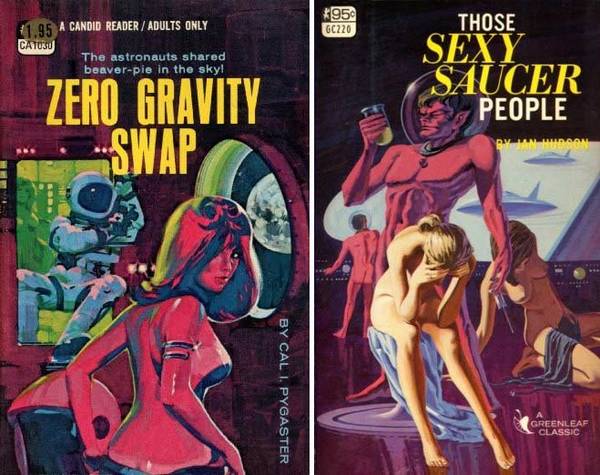
Old pornographic science fiction novel covers - Boing Boing

Old pornographic science fiction novel covers - Boing Boing:
"Efanzines has a small gallery of scans of Greenleaf's notorious pornographic science fiction novels"

Friday, June 18, 2010

What Doctor Gottlieb Saw by Ian Tregillis: Read'n'Tease for Bitter Seeds

Free Readin’ | What Doctor Gottlieb Saw by Ian Tregillis | A Dribble of Ink: "What Doctor Gottlieb Saw by Ian Tregillis

What Doctor Gottlieb Saw by Ian Tregillis

Do you suppose it’s possible to murder God?”


Gretel was Gottlieb’s most troubling patient. She was clairvoyant. She was also, he feared, quite mad."
I've been planning on reading this book for quite a while now. I'll read this short story first. I am heartened with how new authors are using the internet to stay visible in a crowded marketplace.

“What Doctor Gottlieb Saw” takes place roughly 18 months before the events in Chapter 1 of Bitter Seeds. (So it takes place maybe 17 years after the prologue, which you can read for free here.) I wrote it entirely as a standalone, so it doesn’t require any foreknowledge of Bitter Seeds.
Tregillis isn't marketing his book so much as he is creating a reader-friendly environment that satisfies the curiosity of anyone even mildly interested in his book.

Sunday, June 13, 2010

Book Review - China Mieville - The City & The City

For me the detective novel in the sci-fi and fantasy genre has been dominated by Jim Butcher's Dresden Files. The wise-cracking, fire hurling wizard was a noir-style gumshoe who kicked ass and took names. He worked outside the law (both the mundane police and the wizard's council) to solve mysteries and protect his client.

City and the City is another style of detective novel: the police procedural. The protagonist is Inspector Borlú, of Extreme Crime Squad. As in most police procedurals he works within a system where he has to please his superiors, push his subordinates to do their best, cooperate with 'good' colleagues and come into conflict with 'bad' cops. As is also common in many police procedurals, Inspector Borlú has to go rogue to solve the mystery and close the case.

The culture clash while working to solve a crime is reminiscent of the Canadian movie Bon Cop, Bad Cop. Of course, the two cultures are Eastern European(ish) with a hint of Christian-Muslim conflict (although its more Christan-Muslim v. Athiest than anything else).

The atmosphere of the City takes a page from the British urban crime mystery genre. An economically depressed city suffers from an underpaid and overworked police force and an active criminal underclass and corrupt ruling class. Ultra-nationalism. There is no fantastic science in evidence, just a very strange way for a city full of people to live. It is the world-view of the city that makes the book worth reading.

Two cities with a different political and economic system, and distinct cultural mores, share the same geography. Citizens are trained from childhood to completely ignore their opposite city. Mieville ingeniously portrays a world where one must 'unsee' the other city: to willfully and deliberately ignore and avoid anything that is happening in the other city even if its happening right beside you. Failure to do so is harshly punished by Breach, a mysterious organization that acts from the shadows. This socio-political petri dish of a culture (ha!) is well constructed and deftly explored by Mieville.


Jeff VanderMeer on The Best of 2009
China Mieville's The City & The City contains a perfect evocation of an imaginary Eastern European city. Culturally and texturally, Mieville's novel worked well for me, and the writing is to die for. However, as the book progresses the unwieldiness of the central conceit — overlapping cities — and the idea of "unseeing" works less and less well. Mieville's ever more laborious efforts to explain things slow the book down, especially toward the middle, and underscore the somewhat thin characterization. (For an interesting reading experience, pair Mieville's novel with the excellent Red Planets: Marxism and Science Fiction, edited by Mark Bould and Mieville and the recent issue of the scholarly journal Extrapolations devoted to exploring Mieville's fiction.)

SF REVIEWS.NET: The City & the City / China Mieville ☆☆☆☆
The City & the City is China Miéville's best novel since The Scar, and the tightest and most politically observant of his career.

More Reviews:
The City & The City by China Mieville: book review | Bookmarks Magazine

Friday, April 16, 2010

Bitter Seeds: A book I'd like to read soon

Positive reviews from Cory Doctorow (BITTER SEEDS: Alternate WWII novel pits English warlocks against Nazi X-Men), and John Scalzi (The Big Idea: Ian Tregillis) for Ian Tregillis's Bitter Seeds.

Bitter Seeds is an alternate history of WWII with Germany fielding a group of comic-book style supervillians and the British using warlocks and blood magick. It is the first book of a trilogy (Milkweed Triptych).

You can get the Prologue to the book at the author's website.

Tuesday, April 13, 2010

Robert J Sawyer - Flashforward

Physicists at CERN's Hadron Collider fail to create the elusive Higgs-Boson particle, but everyone on the planet collapses and for two minutes experience their lives 21 years in the future. After recovering from the worldwide destruction a number of scientific and philosophical questions are raised. What is the nature of time and consciousness? Is the future fixed? What about free will?

It took me several months to finish this book. While the philosophical concepts that drive the book are interesting, the characters were, while not one-dimensional, boring. The protagonists had to deal with the loss of loved ones as well as the dilemma of living their lives with the knowledge of where they were going to end up in 21 years. With possibly the exception of Theo, who had to deal with a 'certain' future of being murdered, there was no dramatic tension because we really didn't care what happened to anyone.

Sawyer's Calculating God, also work of science fiction with a strong a philosophical depth, was a much more compelling read. The protagonists were sympathetic creations of some substance. Through these characters we were full participants in the discussion -- does god exist, why is the universe set up the way it is -- and enjoyed the story through to the end.

The end of the book takes the a sharp turn from the plodding action interspersed with dense scientific exposition to a 'high-speed' chase followed by a 2001 Space Odyssey-esque journey into the future.

Overall I think, despite finding the book so easy to put down, the story would have been more compelling if it had been a little bit longer. We would have been better served if Sawyer had given us the opportunity to have more of an emotional attachment to the characters before he launched them into this scientific thought-experiment.

Still, the ideas expressed in the book can be found nowhere else in popular literature. It will stick with me for years. For that alone it is worth the read.

The TV series shares the Flashforward science, but the vision is only 6 months into the future. The main storyline involves FBI agents, secret cabals, alcoholism, infidelity, gunfire and explosions. I don't know if the show would benefit from being more cerebral, but I'm sure the book would've benefited from adding (not replacing) the TV show's action and melodrama to existing scientific-philosophical what-if story.